Change Management

- Share with

Our Change management Solutions
We become your trusted change management partner by sharing our resources and knowledge through guided workshops, coaching, and bespoke consulting services. We can help you with anything from resource alignment and change portfolio management to partnering with you to deploy change management on essential projects and develop capability.
You’ll get all the training, tools, technique, and support you need to complete your must-win projects this time, next time, and forever. And you’re bolstering your enterprise change capabilities for the future while also advancing your company’s overall change strategy in the present.
The corporate landscape has transformed substantially as a result of the pandemic. Many enterprises failed at first, but thrived when fresh opportunities occurred.
Businesses are increasingly focusing on new frontiers. Companies’ success depends on excellent change management—and having the tools to support it—as they merge and purchase new assets to boost security, efficiency, and creativity.
Create a Vision
A desired outcome must be identified before change can occur. All too frequently, though, a business makes the error of committing to a mission that is either too restricted in scope or poorly organised. A change management consultant can collaborate with management to create a goal that is both financially sound and hopeful about future growth. Outlining the desired outcome of organised change makes it easier to communicate the goal to all parties involved, helping people to understand and relate to the goal’s benefits for themselves and the organisation.
Create a Change Management Strategy
In order to reach their goals and objectives, companies should work with change management consultants to build a clear change management plan. The first step in establishing an organization’s current ability to change is to conduct a change readiness assessment. Then there’s a risk analysis to discover if there are any potential stumbling blocks to the change’s implementation. The final plan should address implementation, post-implementation, and institutionalisation. Consultants and senior leaders can then use this change management plan to inform and decide whether to implement changes all at once or in stages.
The Change Curve Speeds Up Change and Increases Its Chances of Success
You’ve spent time and money on the most up-to-date systems and processes, as well as training and making your employees’ lives easier (or so you think). People, on the other hand, keep doing things the same way they’ve always done them. What are the anticipated commercial advantages? And when will the turbulence stop?
Organizations do not change simply because new systems, procedures, or structures are put in place. They change and adapt in the same way as the organization’s personnel change and adapt. Individuals may not reap the full benefits of change until they have completed their own personal transitions.
In this essay and video, we’ll look at why personal and organisational change may be so challenging, as well as some ways for making it simpler.
The issue for you as someone who needs to make changes in your firm is to help and support folks through these transitions, which may be quite traumatic at times, involving loss of position and status… and even job.
The simpler this procedure is for people, the sooner your firm will benefit and the more likely you will be successful. If you get this wrong, you risk failing the project – and your career.
The Transformation Curve is a well-known and successful paradigm for comprehending the stages of personal and organisational transition. It allows you to predict how others will react to change, allowing you to assist them in making their own personal changes and ensuring that they have all the necessary guidance and support.
First, we’ll look at the basic concept of the Change Curve. Then we’ll look at how you may use it to accelerate change and boost its chances of success.
What are the Enablers and who are the stakeholders?
Service users, frontline employees, managers, professional bodies, unions, policymakers, donors, children, families, and communities are all examples of stakeholders.
There are various advantages to involving stakeholders early in and during the implementation process:
- Helps create awareness
- Generates buy-in
- Identifies and acknowledges any resistance
- Helps to assess need, fit, feasibility, capacity and readiness.
There are four degrees of potential stakeholder engagement:
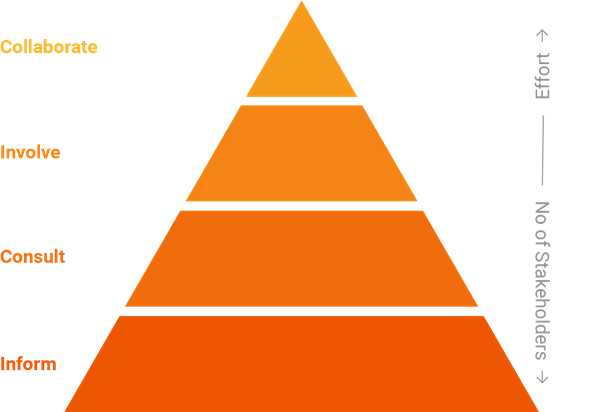
At the summit of the pyramid, collaboration is likely to leave stakeholders feeling invested and engaged in an intervention. For example, co-production is a type of collaboration in which service users, their families, and service providers collaborate to design and implement an intervention. Collaboration that is done right, rather than just lip service, is expensive and time consuming. Neither stakeholders nor intervention organisations profit from a lack of coordination.
The availability of resources is frequently a decisive factor in the extent of interaction with stakeholders. While informing and consulting can theoretically reach a larger number of stakeholders, they only allow for a limited amount of interaction. There’s a chance that people will believe their opinions aren’t being heard. This trade-off must be taken into account.
Capabilities
Value improvement and sustainable growth to business?
Today’s CEOs are confronted with a complex and extraordinary convergence of social, environmental, business, and technological issues. This demands meticulous, long-term upkeep. Executives, on the other hand, are frequently unwilling to include sustainability into their business plans, assuming incorrectly that the costs outweigh the benefits. On the other hand, academic research and real-world experience support the opposite conclusion.
The benefit of embedded sustainability efforts on corporate performance is undeniable. We’ve built a sustainable business case for the 21st century company leader based on our own research and that of our colleagues. This article also presents real instances of how sustainability affects the bottom line, in the hopes of assuaging their anxieties.
Communication
Competent communication skills are necessary at all stages of a change endeavour. Throughout the strategy stage, communication is crucial for building what you want the change to accomplish. It is the process of overcoming employee resistance to change during the planning stage by convincing them of the importance of the change and providing them with the resources they require to perform the job. Regular check-ins to receive feedback and ensure personnel are making the necessary changes are how you keep on track during the implementation stage.
Research
Good academic skills can help you benefit from the information and expertise of others if you don’t have direct knowledge with change management. Examine the most widely used change management approaches to identify which concepts should be incorporated in your projects. Look for actual case studies on major programs to find industry standards derived from real experience.
Leadership
Change management necessitates excellent people management, which includes leadership abilities. Part of this is determining who should be in charge of each step of the change management process, as well as how to ensure that they are appropriately trained to do their duties. You’ll also need to determine how to persuade your employees to accept the change.
Thinking in terms of strategy
Any successful change management endeavour starts with a good strategy. This necessitates the ability to combine a big-picture vision of what the organisation demands with the minute details that are vital to implementation success. It necessitates the development of the ability to anticipate and respond to obstacles that may arise during the change process.